
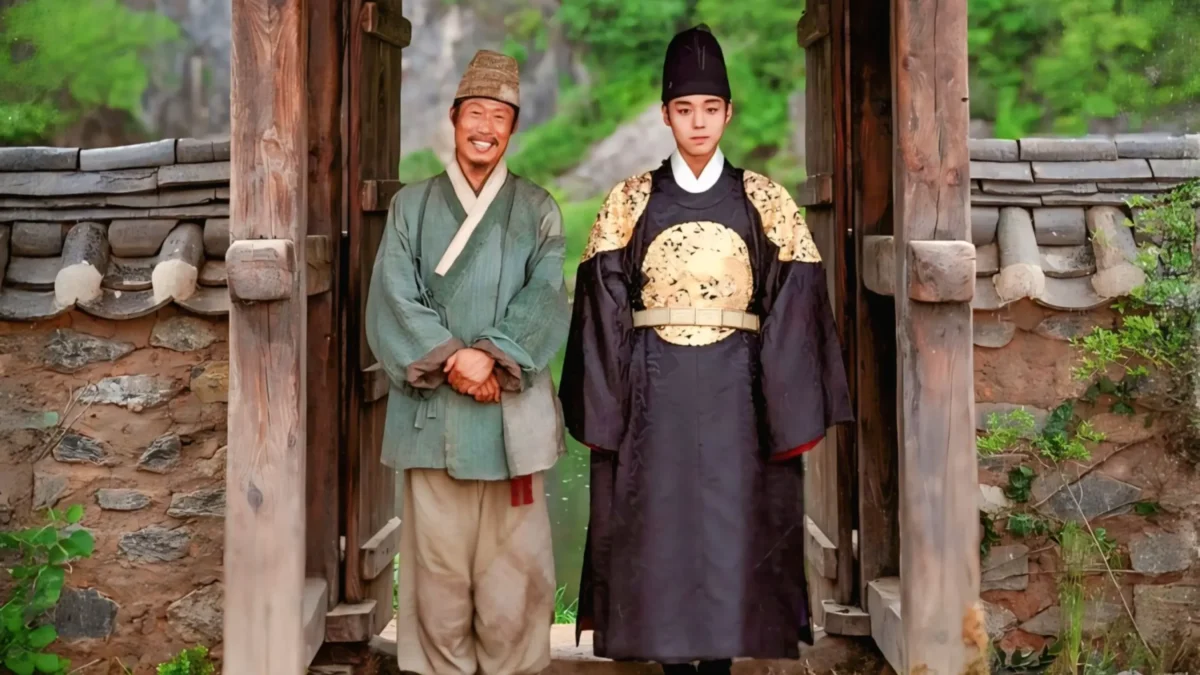
The movie starts with the year 1452, a turbulent time in Korean history. Lee Hong, a mere 12-year-old boy, ascended the throne, but his reign was destined for tragedy. Within a year, his ambitious uncle, Su Yang, staged a bloody coup, seizing the throne and plunging the kingdom into chaos. As the supporters of the young King are brutally tortured and executed, their screams echo through the palace walls. We see Lee Hong sitting in silence, listening to the death knells of his loyal subjects. His faithful Court Lady Man Hwa urges him to eat, but grief has stripped away his appetite.
A Treacherous Encounter and a Rural Escape
Into this somber atmosphere steps Han Myeong, a minister branded a traitor by the people. When Lee Hong asks if he is next to be killed, Han Myeong chillingly dismisses his fears, claiming only the “guilty” are punished. He manipulates the boy King, suggesting that as long as he didn’t actively participate in the rebellion against the new regime, he might be spared—at least for now.
The scene shifts to a remote village where life is dictated by the hunt. Hyeong Do, the village chief, is out hunting deer with his son Tae San. In a tense moment, Hyeong Do is separated from his group and finds himself face-to-face with a massive tiger. He barely escapes with his life, collapsing in exhaustion. He is eventually found and brought to a neighboring village, one surprisingly prosperous compared to his own.
The Secret to Prosperity
In this new village, Hyeong Do is stunned to see white rice and happy faces. He learns that their wealth came from hosting an exiled minister from Hanyang. The Chief explains that the minister educated the children and improved the village’s livelihood. Inspired—and desperate to feed his own starving people—Hyeong Do returns home with a plan. He hears rumors of a new King and the exile of former officials. He believes that if they can secure an exiled minister for their village, they too can taste prosperity.
Meeting the Governor and the Minister
Hyeong Do visits the magistrate’s office and meets Governor Seo Gyeom. He competes with the rival village chief for the privilege of hosting an exile. Using a clever reverse-psychology tactic, Hyeong Do describes his village as a miserable place filled with mosquitoes and freezing winds, arguing that no pampered minister could survive it. Impressed by his boldness, Han Myeong decides to send the most high-profile exile to Hyeong Do’s village: the deposed King, Lee Hong.
The King Arrives in Exile
Lee Hong arrives in the village not as a sovereign, but as a prisoner in a palanquin. During a treacherous river crossing, the boat breaks, and Lee Hong is nearly lost to the water before emerging, soaked and defeated. Meanwhile, Geum Seong, the King’s brother, is secretly plotting a rebellion to restore Lee Hong to power.
Back in the village, Hyeong Do tries to serve food to the former King, but Lee Hong refuses. Hyeong Do, ever the pragmatist, ends up eating the meal himself to report back that the “minister” is being fed. The Governor, Seo Gyeom, orders Hyeong Do to provide updates on Lee Hong twice a month, effectively turning the village chief into a spy.
A Bond Formed in Despair
Tensions rise when Tae San discovers that the “minister” in their village is actually the former King. The villagers are terrified of being labeled traitors. In a moment of deep despair, Lee Hong attempts to take his own life by jumping from a cliff. Hyeong Do saves him just in time, not out of political loyalty, but out of fear that the entire village will be executed if the King dies on their watch.
Slowly, the ice between the two begins to melt. Lee Hong starts teaching the village children, including Tae San, finding a new sense of purpose. He even begins to enjoy the local food, much to the villagers’ delight. However, the shadow of the palace is long. A secret letter arrives from Geum Seong, asking for Lee Hong’s permission to start the rebellion.
Also Read: 6 Must-Watch New Korean Dramas Premiering in May 2026: Your Ultimate Guide
The Tiger Attack and the Turning Point
A dramatic encounter with a tiger in the forest proves Lee Hong’s hidden strength. When the animal attacks the villagers, it is Lee Hong who takes up a bow and kills the beast with a single, perfectly aimed arrow. This act earns him the genuine respect of Hyeong Do and the people.
However, the political climate remains deadly. When Tae San is caught in a restricted area and sentenced to 100 lashes by the cruel Han Myeong, Lee Hong intervenes. Han Myeong humiliates the former King, reminding him he has no power. This spark reignites Lee Hong’s resolve. He sends a secret letter via arrow to his uncle Geum Seong, authorizing the rebellion.
The Ultimate Sacrifice
Hyeong Do is caught in the middle. Han Myeong demands proof of Lee Hong’s treason in exchange for the village’s safety. Hyeong Do discovers Lee Hong’s plan to escape and join the rebels. In a heartbreaking confrontation, Lee Hong tells Hyeong Do to do whatever is necessary to save his villagers.
The rebellion fails. Geum Seong is captured and forced to drink poison. Lee Hong is trapped, and the soldiers arrive to execute him. Knowing that a public execution or forced poisoning would be a final indignity, Lee Hong makes a final, harrowing request to Hyeong Do: “Kill me yourself, so I don’t die by their hands.”
With a heavy heart and eyes blurred by tears, Hyeong Do pulls the rope that ends the life of the young King he had come to love like a son.
The film closes with a powerful note—centuries later, Lee Hong’s royal title is restored, and history finally recognizes his truth. Hyeong Do is remembered as a loyal warden who stood by his king till the very end.
Their graves remain together, symbolizing a bond that defied politics, fear, and death.
The King’s Warden Movie Review
The King’s Warden (2026) is a masterclass in historical storytelling that balances political intrigue with raw human emotion. The film brilliantly portrays the contrast between the cold, calculating world of the palace and the simple, yet profound loyalty of a rural village.
The performance of the actor playing Lee Hong is haunting, capturing the transition from a broken boy to a man ready to face his fate. Hyeong Do’s character arc is equally compelling—moving from a man seeking profit for his village to a protector willing to carry the heaviest burden of all. The cinematography, especially during the river and cliff scenes, is breathtaking. This is not just a movie about a fallen King; it is a story about the unsung “wardens” of history who protected the soul of a nation when its leaders failed. It is a tear-jerker that stays with you long after the credits roll.
